
For years, food & beverage companies invested heavily in manufacturing quality. Modern plants, automated processing, HACCP systems and stringent factory audits became the benchmark. But in 2026, regulators sent a clear message that buck does not stop at the factory gate instead it extends across the entire supply chain.
Recent enforcement actions by FDA of Maharashtra, Karnataka, Uttar Pradesh and FSSAI show that warehouses, distribution centres, dark stores and transport networks are now under the same level of scrutiny as manufacturing plants. The companies that succeed will be those that treat Good Distribution Practices (GDP) with the same discipline as Good Manufacturing Practices (GMP).
Wake-up call
On 13 August 2026, Maharashtra FDA inspected 86 establishments involved in storing and selling food through online platforms. The inspection covered dark stores operated for Blinkit, Zepto and Instamart. The outcome was significant:
- 14 licences suspended
- 60 improvement notices issued
- 1 establishment ordered to stop operations
What is striking is that these were not manufacturing violations, instead they were distribution failures. Inspectors found chilled rooms operating at 6°C instead of the prescribed range, frozen products stored without ante-rooms, food stacked directly on floors, rusted racks, cockroach and rodent infestation, expired stock remaining in picking locations, and failure to follow FIFO and FEFO practices. At one facility, 40 food handlers had no medical records. Some dark stores scored below 50%. These scores were given to warehouses not the factories.
A national pattern is clearly visible and it is not an isolated incident In Maharashtra. Cases are surfacing from Telangana, Uttar Pradesh and other states as well. Most of the cases are revealing gap in overall supply chain practices adopted in distribution channel.
What Good Distribution Practice really means
Many organisations assume GDP is a certificate that can be displayed during inspections. It is not. Actually, GDP is the operational framework that ensures food remains safe after it leaves production. Under the Food Safety and Standards Act, 2006, responsibility for food safety continues through production, processing, import, distribution, storage and sale. Every participant in the supply chain has legal accountability.
A manufacturer is responsible for products leaving the plant. Distributors and wholesalers become liable if they supply expired products, ignore storage condition, handles unhygienically etc. Retailers are equally responsible for hygienic storage and display. If potentially unsafe food has entered the market, businesses are legally required to withdraw the product and inform authorities.
The practical guidance for GDP already exists within Schedule 4 of FSSAI regulations. It is the same hygiene and operational code that manufacturing plants follow, but its storage and distribution provisions are increasingly becoming the regulator’s focus now a days. Some of the basic requirements under GDP are as follow:
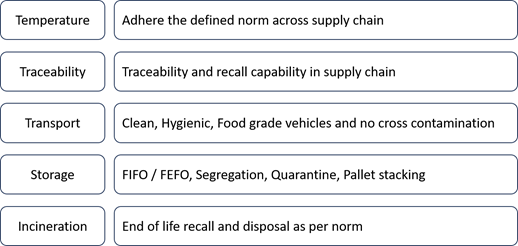
Direct control issue in supply chain
Although regulations are straightforward, but challenge is consistent execution across multiple warehouses, 3PL partners and last-mile facilities. A food or pharma company may operate a world-class manufacturing facility while losing compliance in its distribution network, as overall supply chain network may be comprising of transporters, multi node warehouses, transshipment centres, CFA, distributors, retailers, other channel partners etc. Out of these some may be more vulnerable and type of vulnerability may also differ among stakeholders. In the transportation leg vulnerability may be of temperature, handling quality, transit worthy vehicle availability, wrong stacking or cross contamination while sharing transport network with other categories. On the other hand, distribution centres may be prone to poor pest management, FIFO adherence, weak palletisation or poor storing conditions. In the new age channels dark stores have challenge of space, high inventory turnover and mixed food/non-food products leading to elevated compliance risk.
Process mapping and Audit
One of the most significant gaps in distribution quality compliance is the absence of end-to-end process mapping. While organizations invest heavily in logistics network design and optimization to reduce transportation and warehousing costs, they often overlook mapping the operational processes that govern every node of the supply chain.
A well-designed network defines where products move; a process map defines how they must move. It establishes clear responsibilities, control points, documentation requirements, and quality checks across manufacturing, storage, transportation, distribution, and last-mile delivery.
Effective compliance begins with standard operating procedures (SOPs). You can only audit what has been clearly defined and standardized. Regular internal audits, complemented by unannounced third-party audits, provide an objective assessment of whether processes are consistently followed across the supply chain. Without robust process mapping, SOPs, and independent audit visibility, compliance becomes a documentation exercise rather than a true system of governance and quality assurance.
Distribution quality is the new competitive advantage
The events of August 2026 mark an important shift in India’s food industry. Regulatory attention has expanded from manufacturing excellence to end-to-end supply chain integrity. Warehouses, vehicles, distributors and dark stores are now being evaluated as extensions of the food factory.
Good Distribution Practice is therefore not a quality department initiative, it is a supply chain capability. Companies that standardise processes, audit every logistics node and build real-time traceability will protect both their licence and their brand. Those that treat distribution as someone else’s responsibility may discover that their strongest factory cannot compensate for their weakest warehouse.
0 comments on “When the Warehouse Becomes theNew Factory Floor”Add yours →